Thursday, May 21, 2015

The Writer’s Voice – Never Met, Never Parted

I am thrilled to have won a place in The Writer’s Voice. Thanks to Brenda Drake, Mónica Bustamante Wagner, Elizabeth Briggs, and Krista Van Dolzer for hosting the competition and for giving so many of us the chance to take another step towards literary representation and publication.


My Query

In the spring of 1945, a severely burned German prisoner-of-war is delivered to a Scottish farm to work. Lorna, the farmer’s teenage daughter, soon discovers that in wartime, your family and your allies might not actually be your friends, and your enemy might turn out to be the love of your life. Lorna’s friendship with Paul, and their developing love for each other, is challenged by Lorna’s own prejudices and by the intolerance of her soldier brother and her friends in the village. Ultimately, the events which bring peace to Europe will tear Lorna and Paul apart.

Never Met, Never Parted is a YA Historical novel of 107,000 words. The first book in a pair, it ends as Paul is taken away with the other POWs from Lorna’s village. The second book will follow Lorna across war-ravaged Europe as she tries to find him again.

I am a Scottish writer now living in Houston, Texas. I am an active member of SCBWI, and in 2014 won the SCBWI Joan Lowery Nixon Award for this story. As my prize, I have had the honor of a year's mentoring from Newbery Winner, Kathi Appelt. I am the mother of three teenage readers and writers.


Never Met, Never Parted - First 250 words

Lorna was ankle-deep in cow-shit and milk when she first saw the boy with the steel-gray eyes and only half a face.
Only dimly aware of the rumble of a truck lurching up the lane, Lorna tried to push Caddy and Canny away from the reeking, steaming mess with the broom. The dogs, however, dodged around her and continued to lick up the milk from where it had puddled in the deep crevices between the cobbles, a rare treat for them. Like the dogs, Lorna kept her head down. Her father was raging at Nellie, which made a nice change since it meant that, for once, Jock Anderson’s ire wasn’t directed at Lorna.
“What in the Devil’s name did you think you were doing, you glaikit girl? Can you not even carry a bucket without dropping the damn thing?”
The great farmer’s bulk cast a threatening shadow over Nellie who looked so petite, even in her Land Army uniform of baggy fawn breeches and thick green sweater. Lorna felt a little guilty about not sticking up for her, but Lorna knew Nellie was made of stronger stuff, so she carried on sweeping.
“But Mr. Anderson,” Nellie began, “it was an accident, I—”
“If you’d been concentrating on the matter in hand, lassie, you wouldn’t have all these accidents. Particularly when the matter in your hand is a big bucket of my cows’ milk. This is not an accident, let me tell you, it’s a tragic waste.”

Monday, May 18, 2015

Happiness for Beginners - and having tea and cake with the author is a good start

Katherine Center
Photo credit: Karen Walrond
 What more could a writer and book-lover like me ask for on a sunny Saturday afternoon but the chance to spend a couple of hours sitting at a table covered in sandwiches, cakes and tea, listening to an author tell us about her new book? Not much more, I can tell you.
I was delighted to be included this weekend in what, I suppose, might have once been called a literary salon. Houston author, Katherine Center, gave a group of book-loving women the chance to hear about her new book, Happiness for Beginners, and about her approach to her work
She told us about how she had written her first novel when she was in 6th grade – a blockbuster about how all the members of Duran Duran had fallen in love with her when their car had suffered a flat tire right outside her home. Though it occurred to me that some of the younger women at the table might never even have heard of Duran Duran, there were certainly several more like me who nodded vigorously, no doubt having shared similar fantasies themselves round about 1983 or ’84.
Katherine also admitted to becoming a closet Romance novel fan in recent years, and she talked about the profound effect that had on her own writing in general and on her approach to Happiness is for Beginners in particular. 


“I like the feeling of being happy when I read a book,” she told us, “and that is something I got from reading Romance novels. I started thinking about it with regard to my own writing. Though I don’t write actual “Romance” novels, I do always have a nice juicy, highly delicious love story in anything I write, because frankly I like that stuff. I’m interested that magical connection than can happen between people, because there’s something very special about those moments, so I started trying to harness that goodness in my own books.”
“I realized that in a lot of the books that I’ve read in my life, the thing that has pulled me through the book is worry. Writing teachers will actually tell you to do that, to make your character worry or make your readers worry about the character. But when I became a mom, I discovered that I don’t like to worry. I do a ton of worrying now that I have kids, living with that constant churning in my stomach, and I don’t like it.  What I like about those Romance novels is that what pulls you through them is not worry, but a delicious sense of anticipation, and the knowledge that you are moving towards something good. Even if the hero and heroine have been thrown into a dungeon by pirates, you know it’s going to be okay in the end. Bad things might happen, but you do have this overwhelming feeling that you are moving towards something good.  Though I suppose it’s the bad stuff that gives the good stuff its meaning.”
But how did this epiphany made a difference to Katherine’s approach to her new novel?
“Happiness for Beginners is the first book I have created as a writer since having that realization as a reader. Writing a story is really something you do to a reader. You are making them have feelings so that they invest in your characters, and you lead them through a simulated experience. You are in charge of what you want your readers to feel. I want my readers to feel hope and happiness, and perhaps get a little misty-eyed, but I want them to come out of it feeling grateful and inspired.”
“I try to give people hope, to make them happy, and to make them laugh. And perhaps I can offer them a way to look at the worst situations and see the best way through them.  When I was reading as a kid, it was all about trying to have something to look forward to, and that’s what I’m now trying to give to the world now. If I’m doing it right, I am putting out the kind of books that a reader just can’t stop reading once they’ve started, but also ones that will offer them a new perspective on their own life too.”


Katherine Center’s new novel, Happiness for Beginners, is published by St. Martin’s Press and is her fifth book. Her previous novels are The Bright Side of Disaster, Get Lucky, Everyone is Beautiful and her 2013 novel, The Lost Husband, which is recently been optioned by a movie production company.

For more information about Katherine and all her novels, please visit her website at www.katherinecenter.com


Wednesday, May 13, 2015

Inspiring Houston Women - Dorothy Gibbons of The Rose

I am delighted to have posted another interview on my other blog, Inspiring Houston Women.

Dorothy Gibbons is co-founder of The Rose, a non-profit that provides high quality breast healthcare to women regardless of their ability to pay.  

“For every three insured women who come through our doors for a mammogram we can take care of one uninsured woman. We could do more free screenings, if one diagnostic exam was all that was needed, but by the time they come to us, many of these uninsured women are also certain to need ultrasound and biopsy too. I always tell my staff that until we don't see women with late stage cancer anymore, our job isn't done.”

To read my interview with Dorothy, visit the Inspiring Houston Women blog 

Wednesday, April 8, 2015

Inspiring Houston Women - Chris Cander

I am delighted to have posted another interview on my other blog, Inspiring Houston Women.

Author, Chris Cander, has just published her second novel, Whisper Hollow. She is the mother of two children and also teaches creative writing to elementary school children through Writers in the Schools. Being with children, she says, has brought new insight to her writing: “I have loved looking at the world again through a child's eyes. What we writers do is observe and talk about our observations, so for me to be able to slow down and see things stripped of my prejudices and my knowledge and my experiences has been wonderful.”

To read more from Chris, visit the Inspiring Houston Women blog.

Sunday, December 28, 2014

The fine art of saying thank you


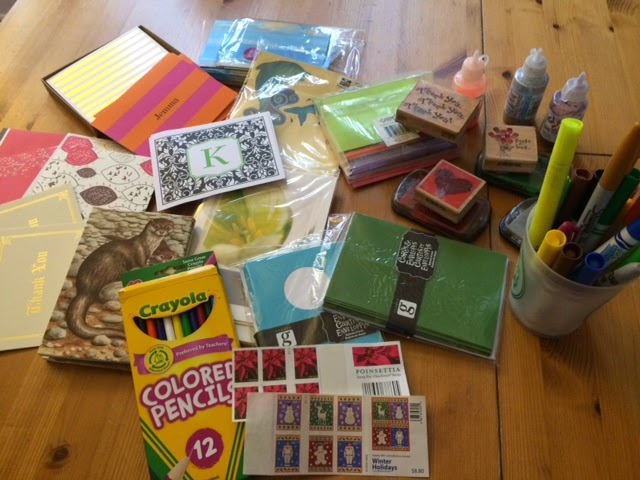
Today’s task is to write thank you cards for all the gifts and hospitality we have received over the Christmas period so far. I have written a list for each child, and for myself, which sets out what present they got from which friend or family member, and there are a dozen different styles of thank you cards laid out on the dining room table all ready for them – cards with thank you printed on the front, cards with their initials, cards with pictures, and cards they can decorate with stamps and inkpads. There is even nice notepaper in case they want to write someone a whole letter. And there are colored pens and pencils for those more artistically driven. There are even stamps and airmail stickers too – for once, I am that organized!

This is something we do after every Christmas and after every birthday, so it really shouldn’t have come as a surprise. And I am proud to know that I have three amazing writers here – my kids are already very successful poets, novelists, screen writers, playwrights and journalists – so writing a handful of single-sided thank yous should not tax them at all. Lucky me!

Yet, when I told one of my kids (I won’t tell you which one) last night what we would be doing first today, I was met with, “But writing thank you cards is boring!” and my heart sank. Have I truly failed, in all these years of writing thank yous, to get them to understand what an important life skill to have this is? Clearly I have.

But then I wondered whether I was the same at 13, moaning about wasting a morning saying thank you for something I could have been playing with instead. I must ask my parents about that. And I must also say thank you to them too, not only for the cool jacket they bought me this Christmas, but also for instilling in me the desire to be grateful for other people’s generosity, and to remember to show it. I know for sure that this habit of writing to say thank you was because all through my childhood they set out the thank you cards, envelopes and lists of gifts for me, and coached me on the best kind of wording and the right way to address an envelope. It is because of their teaching that I place such value on writing – and receiving – thank you cards. And I also know for sure that the vast majority of other people were not lucky enough to have parents doing that same thing for them. Sadly.

I know that, because I can tell you straight away of only one person who without fail has written and mailed a thank you card after every single event he came to at our house. In fact, since he moved away to another state this year and therefore did not come to our Christmas party (though 120 other people did), I actually noticed that the December mail did not bring the usual lovely handwritten note from him thanking us for including him in our gathering and saying how much he enjoyed knowing our family and always feeling that he was welcome in our home. James, if you ever read this – I’ve missed you!

Obviously, I have no right to have a go at those non-card writers I know – and of course I was grateful for the couple of texts and emails that I received to say thank you – but I will allow myself the indulgence of some frustration after the two training courses I gave earlier this year to some mature students. In both training sessions, I stressed the importance of saying thank you, both in their professional lives and personally. What little effort does it take to drop someone a quick note – electronically or in hard copy – to say you appreciated their time, effort and hospitality when they had done something kind for you or had included you in their party? And how big is the impact on the recipient of that thank you, to know that someone was grateful and was not too busy or lazy to let them know? In fact, I stressed this point at least five times in each session, and yet, do you know how many thank yous I received afterwards?

One.

So that set me wondering whether these students (not self-centered teenagers, they were all in their twenties and thirties) had actually paid as little attention to everything else I had been instructing them on. Oh well, time will tell.

So I am heading downstairs now to herd my kids to the dining room, cracking the whip while they moan their way to the table. But I also know that once they get going, this exercise in sharing their gratitude will silence their moans and they will begin to realize how much they received, that it is kind to say thank you. What they might not yet understand, however, is that they are also learning the fine art to saying thank you.

But one day, I know for sure that they will be asking me where the cards are kept because they have a thank you they really want to write.


Tuesday, October 21, 2014

Future Library - a literary treasure trove for the next century

Future Library by Katie Peterson

Recently I heard about an amazing new artwork call Future Library being created in Norway by the Scottish artist, Katie Paterson. But this isn't a painting or a sculpture. This work of art is a forest of trees, and in one hundred years, it will become an anthology of books. Literally! 

Katie Peterson and The City of Oslo have planted a thousand trees in a forest just outside the city. The trees will be looked after until 2114, one hundred years from now.  In each of those hundred years, one author will be commissioned to write a manuscript of some sort and that piece of writing will be placed, unpublished, in a secure and specially designed room in the new public library being built in Oslo. They will all remain unread until the collection of one hundred manuscripts is complete.
Katie Peterson
Then in 2114, the trees will be cut down and the wood will be used to supply paper for a special anthology of books in which 100 years of writing will be published.

Last month, Katie Paterson announced that Canadian author, Margaret Atwood, is the first author to be invited to write and submit something for the anthology which will not be read for a century. Margaret Atwood was born in 1939, but how strange to think that many of the writers who will take part in this amazing artistic concept have not even been born yet (in fact, their parents might not even have been born yet!)
Margaret Atwood and Katie Peterson

The Future Library website has two lovely films about the project.  There is a short movie with Katie Peterson talking about it while searching the forest floor for the tiny trees to be planted, and there is also a wonderful interview with Katie and with Margaret Atwood herself.

I love this idea and hope it does not fall victim the vagueries of local government budget cuts and political posturing. And I so wish that I were the type of person who could have and share the vision for such an optimistic project - optimistic for the future of reading and writing and indeed, for the future of the human race - but I'm afraid I'm just not. I am simply the kind of person to feel enormous disappointment that, chances are, I won't be around to see those beautiful trees become beautiful books around the time of my 147th birthday.

For more information, visit: futurelibrary.no and to keep in touch with the authors as they are invited to take part, Like Future Library on Facebook.
x

Friday, October 3, 2014

The Raven Cycle - the joy and the pain of sequels


Don’t you just hate waiting for a sequel? Remember how long we had to wait for the next Harry Potter, and then the next?  Sweet torture indeed. 

A friend of mine told me just this week that she refused to read any of James Dashner’s fabulous Maze Runner books until the final one was published just so she didn’t have to constantly be waiting for the next book to come out.  I certainly can understand what she means because reading a series of books as they are each published can be quite hard work.  


As an example, I absolutely loved Moira Young’s amazing Blood Red Road, the first in the Dustlands trilogy, but by the time that the second book was published, I realized that I had forgotten much of the detail from the first. So I had to re-read Blood Red Road before starting on Rebel Heart.  But then, of course, when the final book, Raging Star was published earlier this year, I had the same problem, so yes, I read (or rather, listened to on audiobook) both of the first two books again.  Luckily both of them more than stood up to re-reading, even for the third time in the case of Blood Red Road, and having the full story so fresh in my mind meant that final book was even more wonderful than it might have been had I been struggling to remember who, what, where and when led to that opening chapter.

Now, however, I am faced with an even worse dilemma.

If you have recently asked me (or even if you haven’t) what has been the best book I have read over the last couple of years, I will have told you without hesitation, The Scorpio Races by Maggie Stiefvater.  It is not only my favorite book of recent years, but probably my favorite audiobook EVER! Sadly Maggie has been clear that Scorpio Races is a standalone story, and will have no sequel (boo!), but she has given us another beautiful gift in four parts instead.

The Raven Boys introduced us to the lovely Blue and to the boys with ravens on their school blazers, Gansey, Adam, Ronan and Noah, and to the concept of the ley-lines (paths of spiritual energy) which cross-cross the world. It is on one of these ley-lines, Gansey believes, that the legendary Prince of Wales, Owen Glendower, might have passed from Wales to Virginia.  It is a book of spirits and psychics, of good and of evil, but mostly, it is a book about friendships, and leaves you wishing that there was a seat left in Gansey’s orange camaro for you too. Having lived in Wales and made friends with people to whom Glendower feels like family, and then having crossed the Atlantic (by plane, not ley-line, I hasten to add) to live in the US, this book just drew me in immediately.

Then came book two of The Raven Cycle. The Dream Thieves takes us deep into Cabeswater with Gansey and Blue, and even deeper into Ronan’s dreams. And at last, book three is almost here. October 21st sees the publication of Blue Lily, Lily Blue and there will be one more book after that to round off the series.

But here’s my problem.  I desperately want to read it as soon as it comes out, but to do that, I will no doubt have to re-read the first two beforehand.  But then, when book four comes out, I will have to re-read the first three books in anticipation of its release, just to make sure it’s all fresh.  Given that I have dozens of books sitting in my mental to-read list, and thousands more waiting for me to find them and add them to that list, can I really justify reading the same four books a total of ten times (ie Book 1 – Books 1, 2 -  Books 1, 2, 3 – Books 1, 2, 3, 4)? 

Well, given that the four books are The Raven Cycle by Maggie Stiefvater, the answer has to be ‘Hell, yes!’

And if you haven’t yet read Raven Boys or Dream Thieves, by my reckoning, with three weeks to go until publication date, you should have just enough time to read them both if you start right now! Go on, get on with it!

To see more of what writer, musician and artist Maggie Stiefvater gets up to (including a video painting a really cool graffiti knife onto her own car, just like the one in Dream Thieves) visit her at: maggiestiefvater.com

And you can also visit You Tube to see the unnerving new trailer for Blue Lily, Lily Blue.